Sunday, May 29, 2016

Pyrochroa coccinea_cardinal beetle_Munich_Germany_May 2016

Pyrochroa coccinea is a cardinal beetle (there are at least three different species of cardinal beetles) that belongs to family Pyrochroidae. Pyrochroa coccinea is common in Europe. Some interesting facts about these insects:
- the larvae stage is very long, lasts 2-3 years;
- they produce a poisonous substance, catharidin, which is a terpene that inhibits protein phosphatases 1 and 2A;
- if there is not enough food they can switch to cannibalism.


Pyrochroa coccinea

Friday, May 27, 2016

Ladybird Mating_Munich_Germany_May 2016

Spring is obviously a mating time for many animals, especially for the insects. Today I have seen a mating 17-spot Harlequin ladybird. The Harlequin ladybird (Harmonia axyridis) is also known as Asian ladybeetle or Halloween ladybeetle and belongs to the family Coccinellidae. The Harlequin ladybird is native to Asia, but currently is spread to all continents, with the exception of Australia and Antarctica.
In Europe, from October until February the ladybirds hibernate, usually in large groups. In March-April they become active and search for the food e.g. aphids. May is a mating time for the ladybirds. After the mating, the ladybirds lay eggs, from which the larvae are hatched (June-July). The larva will change the skin 4 times. Afterwards, the larva will attach to a leaf or a stem and turn into a pupa. In August, an adult ladybird will develop from the pupa.

Interestingly, the larvae of the Harlequin ladybird can eat up to 370 aphids, whereas the adult forms can eat even 5,000 aphids during their lives!


Thursday, May 12, 2016

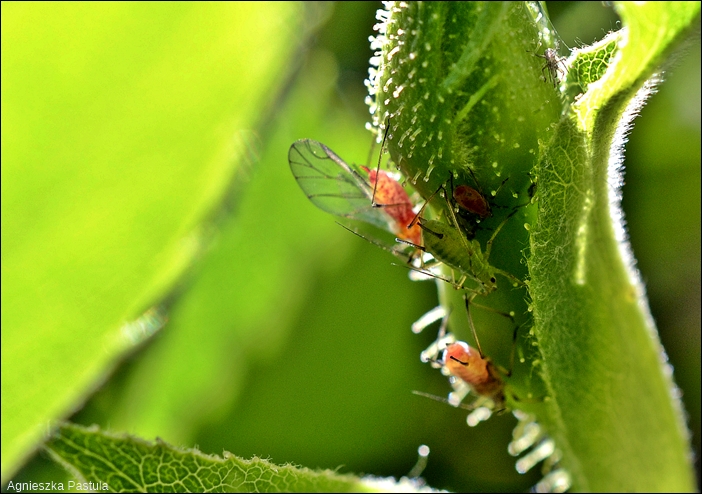
Aphids On Rose Bushes_Munich_Germany_May 2016

Today it has been a rainy and grey day in Munich. Although usually I do not like rainy days, one of my favourite photography motifs are the water drops. While photographing the water drops on the roses, I noticed plenty of tiny insects (approximately 3-4 mm length): some were brown, while other green and thus perfectly matching to the color of the rose stamen. Those insects were the aphids. 


Sunday, April 24, 2016

Magnolias in full bloom_Munich_Germany_April 2016


     Magnolia is an ancient flowering plant that belongs to the family Magnoliaceae. The name of this plant comes from the name of a French botanist, Pierre Magnol. Together with palms, magnolias belong to the prehistoric plants - magnolias are believed to be on our planet for at least 95 million years! Interestingly, magnolia is pollinated by beetles (when magnolias appeared the bees did not exist yet). 


Friday, April 22, 2016

Caterpillars in New Orleans_Louisiana_US_April_2016

Caterpillars are the larval forms of moths and butterflies. Some caterpillars are equipped with the stings and a poison, to protect themselves against the predators. During my 7-day stay in New Orleans, I observed two caterpillars: one contained spikes (the buck moth), while the other one was hairy. They were on sidewalks. Both were walking pretty fast. Since caterpillars can sting people and trigger allergic reactions, it is better not to touch them.


The buck moth (Hemileuca Maia) caterpillar, New Orleans.


Some another type of caterpillar, New Orleans.


Friday, April 8, 2016

Spring in Washington DC_US_April 2016


Flowering dogwood (Cornus florida)


Flowering dogwood (Cornus florida)


Fritillaria melagris


Narcissus